You, the first-time reader of The Lord of the Rings, experience the events of the story exactly as some of its more unknowing characters do; that is, you have no idea what’s going on: there’s all this talk about destroying the One Ring, which you’ve come to understand is essentially a symbol of pure evil, corruption, temptation, and power. But, you’re really just along for the ride, simply out of sheer loyalty to your comrades. You’re a hobbit in way over your head. In the company of your quest – yes, you’re on a quest now – are three other hobbits, two men, a dwarf, an elf, and a wizard. Just a few months ago, you knew next to nothing about any beings other than your fellow hobbits. You still really don’t. Now again you’ve come to understand that your road must cross a mountain range, and your company has elected to try the pass under the mountains via “Moria,” despite some misgivings from some of the other members of your company, though for reasons you don’t understand.
Narrowly avoiding death from some old and foul monster from the deep places of the world, you now find yourself sealed in the utter darkness of Moria, whatever that is, with the reasons for the misgivings becoming ever-clearer. Gimli, the lone dwarf in your company, grows somber, but leads your company through the endless dark with Gandalf, your wisest guide and wizard, whose staff blares the dullest light. From what little you can see, and the echos tricking all around you, you can tell you’re in some unfathomably massive cavern.
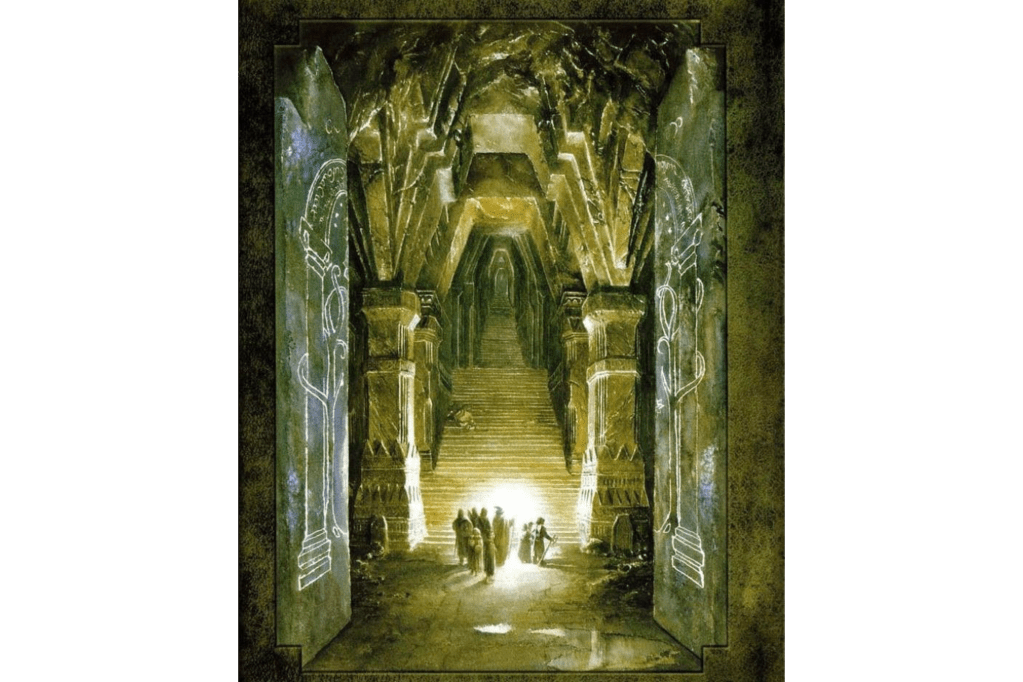
After an endless march in the dark, anxiety threatening to suffocate you, Gandalf and Gimli halt. You can rest. But Gandalf risks a little light; a great lightning emanating from his staff illuminates ancient halls around you. You all gasp as the flash reveals many mighty pillars hewn of the mountain itself supporting the vast roof and housing a huge empty hall, Moria. Then, as your mind is still processing all you’ve seen in the quickly dimming glow, Gimli announces: “This is the great realm and city of the Dwarrowdelf. And of old it was not darksome, but full of light and splendor, as is still remembered in our songs.” Then, rising in the dark, he begins to chant in a deep voice:
(follow along as Tolkien himself recites The Song of Durin – link)
The world was young, the mountains green,
No stain yet on the Moon was seen,
No words were laid on stream or stone
When Durin woke and walked alone.
He named the nameless hills and dells;
He drank from yet untasted wells;
He stooped and looked in Mirrormere,
And saw a crown of stars appear,
As gems upon a silver thread,
Above the shadow of his head.
The world was fair, the mountains tall,
In Elder Days before the fall
Of mighty kings in Nargothrond
And Gondolin, who now beyond
The Western Seas have passed away:
The world was fair in Durin’s Day.
A king he was on carven throne
In many-pillared halls of stone
With golden roof and silver floor,
And runes of power upon the door.
The light of sun and star and moon
In shining lamps of crystal hewn
Undimmed by cloud or shade of night
There shone for ever fair and bright.
There hammer on the anvil smote,
There chisel clove, and graver wrote;
There forged was blade, and bound was hilt;
The delver mined, the mason built.
There beryl, pearl, and opal pale,
And metal wrought like fishes’ mail,
Buckler and corslet, axe and sword,
And shining spears were laid in hoard.
Unwearied then were Durin’s folk;
Beneath the mountains music woke:
The harpers harped, the minstrels sang,
And at the gates the trumpets rang.
The world is grey, the mountains old,
The forge’s fire is ashen-cold;
No harp is wrung, no hammer falls:
The darkness dwells in Durin’s halls;
The shadow lies upon his tomb
In Moria, in Khazad-dûm.
But still the sunken stars appear
In dark and windless Mirrormere;
There lies his crown in water deep,
Till Durin wakes again from sleep.
You have no idea what any of this means, but still the magnitude of the moment and the privilege you’ve experienced is not lost on you.
Hobbit no longer, you are now Gandalf, likely the only one in your company of nine fully able to appreciate the generosity and magnanimity of Gimli’s song. For Dwarves are notoriously secretive, and Gimli sharing his song with you is the deepest honor such a fine folk can bestow. Aided by your wizardly knowledge, his song has deepened your own understanding of the connections of the world.
Some 10,000 years before this journey of your company, the first seven Dwarves were created, of whom Durin, King of Durin’s Folk, was oldest and foremost among them, and of whom Gimli now sings 10,000 years later. He founded this greatest Dwarf-kingdom the world had ever seen, Moria. For 9,000 years few other accomplishments could rival its greatness – its magic – in all of Middle-earth: while kingdoms of Elves and Men crumbled one by one, Moria endured.
But just a thousand years before your journey with your company, after years of slow decay, Moria eventually failed. This is a central theme in Tolkien’s writing: at the time of the events of The Lord of the Rings, the races of Elves, Men, and Dwarves were each cowering in the shadow of their former glory. That is, their realms, peoples, and magic, were deep in the throws of decline.
Gimli is the direct descendent, after all this time, of Durin, and Moria is his peoples’ ancestral homeland from which they fled in terror and death a thousand years ago. Efforts had been made to reclaim it, but all had failed, and ever since, Moria has sat as a haunted tomb.
So, Gimli’s song begins accurately: when Durin woke, he gave name to all he saw around him. With the next verse, the world being fair is but a distant myth reconnecting us to this theme of decline: Gimli laments the world is fair no longer: Moria has fallen, Dwarves are weak and scattered, and the world is grey and the mountains old. Similarly, in Elder Days, Gimli is referencing the great Elvish kingdoms that Moria outlived and that suffered their own decline and destruction long ages ago.
For fear of spoiling the magician’s trick, I’ll leave the rest to you.


Leave a Reply