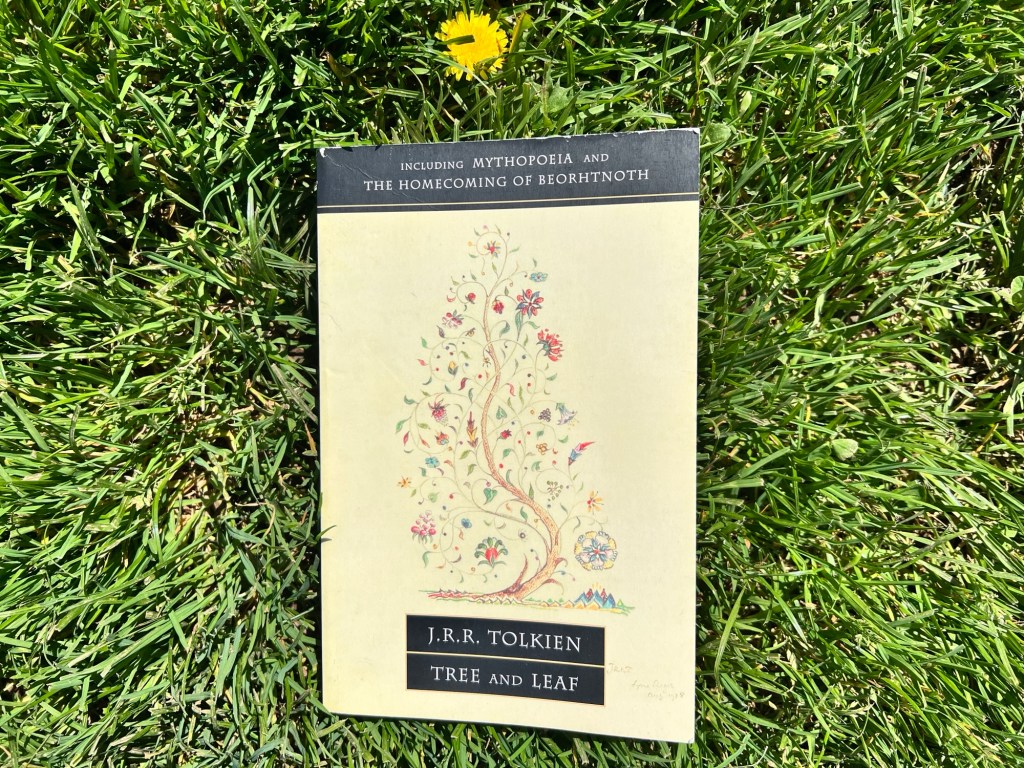
The road to Faërie is a perilous one. For starters, the realm itself is indescribable (though not imperceptible). If we are to commit to this journey, “we must travel hopefully if we are to arrive.”
While in early development of The Lord of the Rings, J.R.R. Tolkien wrote an essay titled On Fairy-Stories in which he reveals many of the elements defining and underpinning the success of fairy-stories, with many of these being instantly identifiable in his epic. Further, Tolkien expands on the special offerings these fairy-stories provide with the throughline of desire.
The Fairy-Story
Tolkien supplies the traveler with some fundamental clues about what makes a ‘fairy-story’. Consider the following quotes:
“Fairy-stories are not… about fairies or Elves, but about Fairy, that is Faёrie, the realm or state in which fairies have their being.”1
Tolkien 9
“Most good ‘fairy-stories’ are about the aventures of men in the Perilous Realm or upon its shadowy marches.”2
Tolkien 9-10
“Fairy-stories… were primarily concerned with… desirability. If they awakened desire, satisfying it while often whetting it unbearably, they succeeded.”3
Tolkien 40-41
“A story may thus deal with the satisfaction of these desires… and in proportion as it succeeds it will approach the quality and have the flavour of fairy-story.”
Tolkien 13
Accordingly, while defining the Perilous Realm setting of fairy-stories, Tolkien weaves his thesis of desire through the genre’s offerings of Fantasy, Recovery, Escape, and Consolation.
Fantasy
“Fantasy, the making or glimpsing of Other-worlds, was the heart of the desire of Faёrie.”
Tolkien 41
Fantasy – world-building – is the vehicle fairy-stories use to engage human desire. Tolkien describes the Fantasy process as a composition of “a quality of strangeness and wonder” and sub-creation. Regarding the former:
“It is precisely the colouring, the atmosphere, the unclassifiable individual details of a story, and above all the general purport that informs with life the undissected bones of the plot, that really count.”
Tolkien 19
Sub-creation is one of Tolkien’s key concepts. In it, Man himself can only ever be a secondary creator processing the primary materials of God into something new. Successful sub-creation as Art arises when the story-maker’s expression of his imagination achieves an ‘inner consistency of reality.’ With this achievement, ‘suspension of disbelief’ becomes unnecessary because inside the story-maker’s Secondary World, “what he relates is ‘true’: it accords with the laws of that world.”
“To make a Secondary World… commanding Secondary Belief… will certainly demand a special skill, a kind of elvish craft. Few attempt such difficult tasks. But when they are… in any degree accomplished then we have a rare achievement of Art: indeed narrative art, story-making in its primary and most potent form.”
Tolkien 49
“Art is the human process that produces… Secondary Belief. Art of the same sort, if more skilled and effortless, the elves can also use… but [to] the more potent and specially elvish craft… Enchantment, Fantasy aspires, and when it is successful of all forms of human art most nearly approaches.”
Tolkien 53
Tolkien elaborates that elvish ‘magic’ is this sub-creative Art, but takes pains to distinguish it from the Magician’s trick, with the differentiating factor being the root of desire. Art’s desire is “shared enrichment [and] partners in making and delight” whereas:
Magic… is not an art, but a technique; its desire is power in this world, domination of things and wills… [T]he greed for self-centered power is the mark of the mere Magician.4
Tolkien 53
Recovery, Escape, Consolation
Fairy-stories help us recover a clear view, one often shrouded by anxiety, boredom, and weariness, by instilling in us a child-like wonder to see the familiar with new eyes, as things apart from ourselves, thereby healing us from possessiveness:
“Creative fantasy… may open your hoard and let all the locked things fly away like cage-birds. The gems all turn into flowers or flames, and you will be warned that all you had (or knew) was dangerous and potent, not really effectively chained, free and wild; no more yours than they were you.”
Tolkien 59
Utilizing escape, fairy-stories help us satisfy both ancient desires and “our present time and self-made misery.” Freeing us from our limitations, in fairy-stories we can survey the depths of space and time, explore as a fish the deep sea or as a bird the open skies, and communicate with other living things.5 However,
“there is the oldest and deepest desire, the Great Escape: the Escape from Death… Few lessons are taught more clearly in [fairy-stories] than the burden of that kind of immortality.”
Tolkien 68
There are countless examples in The Lord of the Rings of this temptation of immortality6 – most with terrible consequences – because when Tolkien says fairy-stories are about satisfying desires that does not necessarily mean granting or indulging them, but rather providing consolation for them.
After making some progress on this analysis, I lay in the green grass on a beautifully pleasant early spring day, gazing longingly at the rich blue sky with its forever clouds. With the sun’s magnificence forcing my eyes to yield, I realized my desire: to watch unblinking the sun-stroked rolling clouds. Unemployed at the time, I then saw this desire as a metaphor for being able to enjoy life without worrying about the cost of living. However, underneath this worry, I realized, is the threat of death; but it wasn’t until later that consolation finally struck: that it is precisely because our time is finite that we value it.
Consolation
Eucatastrophe – the good catastrophe – is another of Tolkien’s central theses. Here is how he describes the concept:
“Tragedy is the true form of Drama… but the opposite is true of Fairy-story… I will call it Eucatastrophe. The eucatastrophic tale is the true form of fairy-tale, and its highest function.”
Tolkien 68
“The good catastrophe [is] the sudden joyous ‘turn’… a sudden and miraculous grace: never to be counted on to recur… it denies universal final defeat and in so far is evangelium, giving a fleeting glimpse of Joy, Joy beyond the walls of the world, poignant as grief.”
Tolkien 68-69
“It is the mark of a good fairy-story… that however wild its events… it can give to a child or man that hears it, when the ‘turn’ comes, a catch of the breath, a beat and lifting of the heart, near to (or indeed accompanied by) tears… A tale that in any measure succeeds in this point has not wholly failed.”
Tolkien 69
The eucatastrophic moment in The Lord of the Rings is the destruction of the One Ring after our hope evaporates with Frodo’s failure and Gollum’s treachery. It is (literally) a miraculous denial of universal final defeat. This evangelium, this glimpse of Joy – this consolation – is, perhaps, that if we commit ourselves so wholly and selflessly to hope and goodness, as Frodo and Sam did, our arrival, our defeat of darkness, is all but inevitable.
Final Notes for the Faёrie Writer
In addition to showing how fairy-stories are about desire, sub-creation, and eucatastrophe, Tolkien shares more directions that further make the essence of fairy-stories felt.
The classic opening “once upon a time” is time-specific for a reason:
“As for the beginnings of fairy-stories: one can scarcely improve on the formula Once upon a time. It has an immediate effect… It produces at a stroke the sense of a great uncharted world of time.”7
Tolkien 81
While fairy-stories can have many functions and take many shapes, within them, one of the sacred elements is the magic itself. It is the “one thing [that] must not be made fun of… [it must] be taken seriously, neither laughed at nor explained away.” Tolkien gives two examples:
“The necessity of keeping promises (even those with intolerable consequences)… together with observing prohibitions, runs through all Fairyland. This is one of the notes of the horns of Elfland, and not a dim one.”8
Tolkien 67
Similarly, fairy-stories must be presented as true:9 “[they] cannot tolerate any frame or machinery suggesting that the whole story… is a figment or illusion.” As a young child, I loved the book series Geronimo Stilton, but I vividly remember that my disillusionment was so intense with the ending of one of the stories – which revealed that Geronimo’s adventure had all been a dream – that I never read another work in the series: it shattered the enchantment.
Tolkien created the consolation of eucatastrophe as distinct from the concept of the happy ending because “there is no true end to any fairy-tale.”10 For this reason, quintessential endings such as ‘and they lived happily ever after’11 are actually especially well-suited for fairy-stories because:
“such tales have a greater sense and grasp of the endlessness of the World of Story than most modern ‘realistic’ stories.”
Tolkien 80
“[Such endings do] not deceive anybody… and are no more to be thought of as the real end of any particular fragment of the seamless Web of Story than the [picture] frame is of the visionary scene.”
Tolkien 80
Lastly, Tolkien encourages the aspiring artist to not worry overmuch about originality because for somebody, your expression will be the first time they experience that perspective:
Spring is, of course, not really less beautiful because we have seen or heard of other like events… Each leaf, of oak and ash and thorn, is a unique embodiment of the pattern, and for some eye this very year may be the embodiment, the first ever seen and recognized, though oaks have put forth leaves for countless generations of men.”
Tolkien 56-57
Doubt strikes. We reach again for our roadmap to Fairyland, but the landmarks all look familiar, the signposts indecipherable, and the locals conspiratorial. Enchantment falls on our lips, and a familiar tune reaches the ear…
The Road goes ever on and on
Down from the door where it began.
Now far ahead the Road has gone,
And I must follow, if I can,
Pursuing it with eager feet,
Until it joins some larger way
Where many paths and errands meet.
And whither then? I cannot say.
Footnotes
- We see the last explicit usage of the term ‘Faёrie’ in The Hobbit; it is synonymous with Valinor, the realm of the Elves, and goes by that name thereafter in The Lord of the Rings. ↩︎
- The Lord of the Rings is set in the shadowy marches of Faёrie, Middle-earth, with the last remnants of the fairies (Elves). ↩︎
- Tolkien writes “the dragon had the trade-mark Of Faёrie written plain upon him… I desired dragons with a profound desire.” We see this desire come to life as Smaug in The Hobbit, among others. ↩︎
- Sauron is a Magician (the Necromancer), not an artist: while he did use skillful craft to create the Rings of Power, he did so out of a desire for domination, not shared enrichment. ↩︎
- Examples include Treebeard in The Lord of the Rings and Smaug and the thrush in The Hobbit. ↩︎
- For example, the men of Númenor betray the gods due to their jealousy of the Elves’ immortality. See 4: Even the Elves themselves seek the deathlessness of their realms – this is why they succumb to Sauron’s offer of creating the Rings. Because of this, their artful endeavor is corrupted with magic and their realms must fade with the destruction of the One Ring. Contrast this with the protagonists of The Lord of the Rings. They also sought “preservation,” but of freedom. Since their desires were pure, so was their ‘magic.’ For example, Gandalf uses ‘magic,’ but it is largely in the form of inspiring hope, and his ‘methodology’ in doing so is Art, not magic. ↩︎
- Tolkien’s quintessential version of this is the beautiful opening to The Hobbit: “In a hole in the ground there lived a hobbit.” ↩︎
- Keeping promises: Consider Sam’s promise to Frodo: “Don’t you leave him! they said to me. Leave him! I said. I never mean to. I am going with him, if he climbs to the
Moon; and if any of those Black Riders try to stop him, they’ll have Sam Gamgee to reckon with, I said.” The quest to destroy the Ring is rewarded because Sam fulfilled his promise.
Observing prohibitions: Both Frodo and Faramir curse Gollum. Frodo says, “If you touch me ever again, you shall be cast yourself into the Fire of Doom.” Faramir says, “And may death find you swiftly, within Gondor or without, if you do not well serve him.” (This in addition to Gollum himself violating his promise he swore “on the precious.”) ↩︎ - Tolkien pretended he was merely a translator of a discovered text, the Red Book of Westmarch, not the author (that being Bilbo, Frodo, Sam, etc.) ↩︎
- The Lord of the Rings is the story of the War of the Ring, but the reader often stumbles upon elements revealing that it is just one of many parts in Tolkien’s far more expansive Web of Story. ↩︎
- Outlooks on endings in The Lord of the Rings are shaped through the impact of adventure. (Largely) uncorrupted Bilbo has an innocent and romanticized ending to his memoir There and Back Again. He says, “I have thought of a nice ending for it: and he lived happily ever after to the end of his days.” Compare this to Frodo, who, as a function of his fall from innocence, cannot go on, but leaves space at the end of his story for Sam to continue. Through Sam, who is much more able to recover than Frodo, Tolkien is able to create an ending to The Lord of the Rings that acknowledges its continual nature, closing with “Well, I’m back,” as if his part in the War of the Ring was an obligation he had had to deal with before he could return to his ‘real’ life. ↩︎
Works Cited
Tolkien, J. R. R. “On Fairy-Stories.” Tree and Leaf: Including “Mythopoeia”, HarperCollins, 2001, pp. 3-81.


Leave a comment