When in Rome, do as the Romans do.
This instruction suggests that one ought to participate in an environment’s modus operandi. For example, find yourself in Portland? Drink coffee and ride a bike (though maybe not simultaneously).
I like this expression and employ it regularly, though I’ve since debased it to the point of being indistinguishable from the other well-known expression “strike while the iron is hot”. While both are clearly about seizing opportunity, and the latter is more true to my use, the former is more fun to say. It encourages me to say yes to invitations and to engage.
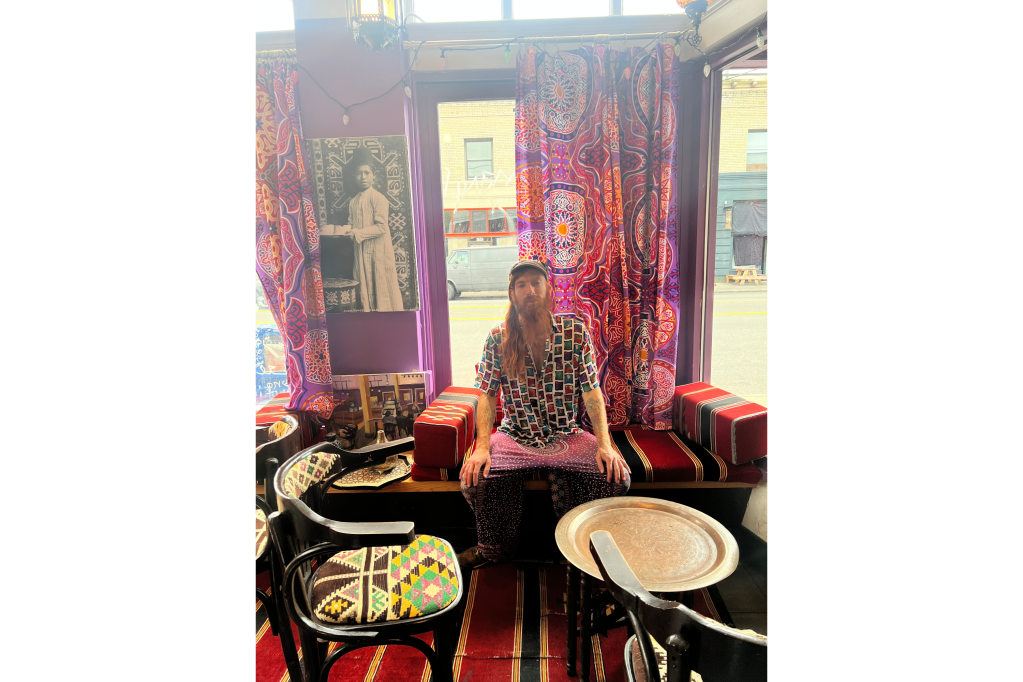
The other day, I bumped into my artist acquaintance (now friend) Red Van Grow. We talked briefly and split ways but agreed to meet up for coffee in just a few minutes. But, not yet fully processing that I’d see him so soon, I gave him my business card, pointing out my blog as we said goodbye. I arrive at the coffee shop, those few minutes pass, and in walks Red Van Grow, who sits down next to me and says, “so when are we doing the interview?” Now, I had no idea what he was talking about, but, in my way of doing as the Romans do, I welcomed the opportunity. We scheduled to meet up again the following day for me to ask him questions…but about what, I didn’t know. He then poured out a bag of buttons and pins and we connected studying and commenting on them together. I looked at him and couldn’t help but think of him as a more positively eccentric version of myself.
Fortunately, the answer to the riddle came quickly. Red being the artist extraordinaire, I decided I’d interview him about art, and the questions I’d ask came shortly thereafter. The following is a selection of that interview.
The Artist’s Endurance
“My main focus for my life is art in general.”
Red Van Grow
Committing oneself to art, like most things worth doing, isn’t easy. Sitting in one of his favorite coffee shops, surrounded by his artwork and gentle music playing, I asked him, “What does art mean to you?”
“Art is everything… there’s no way around it… Therefore, I create to create. And there’s no other way I can describe it without getting too technical, because then that would step away from the whimsy and the magic of creating.”
Unfortunately, there’s also no way around needing to be able to afford to live. Red shared that the temptation of money has been a stressor for him recently because it directly contradicts his purpose:
“I’ve been stepping too close and wanting to make money on my art. And I’ve been stressed because my art’s not meant to make money. My movement is meant to encourage people to do art. And the money comes.”
Questioned on whether money itself is corrosive to his mission, Red responded, “I see the thought of needing more money than I need as the corrupting element.”
However, Red revealed that despite a near-sole focus on making art every day, having enough money to cover rent and essential expenses is still a constant struggle. He summarizes:
“Every month has been convincing me that it’s hard to be an artist. But every month I have finished the month saying, I love being an artist.”
Despite this conviction, the constant struggle has been so prominent to him lately that it has even been affecting his ability to maintain a hope in art. This peaked my interest since Hope in Decline is a central motif of mine and it naturally segued into a question I had pre-prepared.
I asked Red, “How does hope fit into all this, the artistic process? Is it necessary? Naïve?” He defined hoped as a looking-forward-to of things, saying that “it’s what brings me the strength to continue painting to completion.” He elaborated:
“Hope is something that requires energy and initiative. You can’t just simply have hope. You have to express. And then you have to upkeep it. And if you have hope too long, it becomes stale. If you do not act promptly, then your hope becomes a want. And a want becomes a future thing. And a future thing isn’t here, [but] a fleeting desire.”
“It’s the hope that whenever I see someone that is in need, I can help them with my art, because that’s what I have.”
Connecting to this idea that we must travel hopefully if we are to arrive, Red expands on some of the ways that he strikes while the iron is hot:
“So I haven’t been asking myself permission to do things lately… We can’t fear too much, for if we fear too much we will never do the things we want to do.”
InfraRed
I then asked Red about his artistic process and mindset and how they’ve developed over the years. Here are his responses:
“When I was probably like 11 or 12 years old, I had noticed that the colors were on the page: there wasn’t black and white. I don’t see black and white. I can’t. I create – actively – color to fill in the black and white, everywhere, even on the ceiling. And that’s one of the conditions that I appreciate most about my mental awareness: [that] nothing doesn’t have artistic design.”
“I don’t do the work. I am a vessel that guides the brush. It’s like a mechanism that is spontaneous. If I have a brush in my hand and paint on the brush, there’s going to be a picture at the end. There’s no artist block. There’s no me staring at a canvas. I could close my eyes and there’d be a painting when I’m done.”
“I told myself for a long time – like everybody tells themselves – that I didn’t know how to paint. If you ask me how to paint, by now I can tell you. I can tell you all the ins and outs of how to paint or I can just give you a paint brush. Honestly, I would never tell you how to paint. You already know how.”
Beside him sat his recently painted picture of a whale, to which I pointed, inquiring if he knew that’s what he wanted it to look like:
“I wanted a painting. And the whale was a goal. And that’s it. I can’t have too many technicalities because they’re unimportant: the painting will come out regardless. But if we think too much about what we know how to do, we will have already not done it enough.”
On Overthinking
I asked Red a two-part question: How do you keep creating even when blocks inevitably come? And what advice would you give to the artist struggling with self-doubt or uncertainty over where to begin?
Before breaking into an illuminating story, he answered, “Artist’s block (writer’s block) is over-defining, over-generalizing, before you even start.” He continued:
“Someone said yesterday to me, ‘I wanna be a better artist,’ and I said, ‘why would you want to be better?’ To be better than something is to compare yourself to something, and then you’re not doing [art] because… one second of comparing is one second you wouldn’t be encouraging growth.
He then mimed two cups:
“The more we compare glass cup [and] paper cup… [the more] we’ve already let the drink get cold because we’ve been sat here thinking about the cup when we need to understand that they are both the same: they are both a vessel of holding and they both were created with a responsibility and a strength to be a cup. Regardless of the material the cup is made of, it’s still going to hold our liquid.”
Seeing Red
Seeing Red is anything but madness. It is to understand that his life is a commitment to art. However, painting alone is not his sole artistic endeavor. Indeed, Red Van Grow is six chapters deep into writing a book connected to the themes often seen in his paintings. This story is about Jack Hobosh, the Pumpkin King.
Red’s work follows the inception of Jack Hobosh from a sprouting seed to his discovery and leadership of the Mushroom Sprites. In these adventures, we see the story’s central theme: to be knowledgeable is to be both a teacher and a student. For example, we see this theme when the characters help alleviate bad dreams. Van Grow says:
“[Jack Hobosh] learns that his purpose through his lineage was to guide the Mushroom Sprites to the edge of Dreamland so that they could then enter our dreams and influence them how they should be.”
In a similar vein, to close out our interview, I wanted to know about Red’s favorite work of art. Excitedly, he quickly directed me to his website where he showed me his piece called Filling the Vastness:
“Here you can see a Vastness – just a coalition of all the things… Right here we have a Mushroom Sprite, and they have a bowl full of knowledge, and they are filling the Vastness and creating it all. But, they’re not the creator; they’re the vessel… The Vastness didn’t come… until they actively said, ‘this is a Vastness and I’m going to dump it out of the bowl…’ And so this is a representation of all art as a soup. You can eat the soup, you can be the fly that lands in it, you can be the conversation about the soup; but it’s all soup. So that’s my favorite painting.”
La Red
Reflecting on this experience, from saying yes to the surprise opportunity arising from the business card, to the bag of buttons and pins, and ultimately to the interview itself with Red Van Grow, I realized something: the Color of Art is Red. That is, I saw myself in Red because Red is all of us – rather, art is all of us. And as an embodiment of art, Red shows us that we’re all connected by a universal human desire and ability for expression and creativity.
Instagram @RedVanGrow
Website RedVanGrow.Art
CashApp $gypsybyn8ture


Leave a Reply